01
Customer-specific requirements
Are requirements from supplier manuals, quality agreements, audit reports and portals known, assessed and translated into processes?
Automotive suppliers face high pressure: customer audits, complaints, delivery performance, change management and reliable metrics need to work together.
Even when not every company needs IATF certification, automotive customers often shape requirements for quality, evidence and response speed.
I support stabilization of ISO 9001 processes, complaint logic, action tracking and audit preparation.
The focus is on robust interfaces: understand customer requirements, control changes, close complaints effectively, manage suppliers and use metrics so management and customers see the same situation.
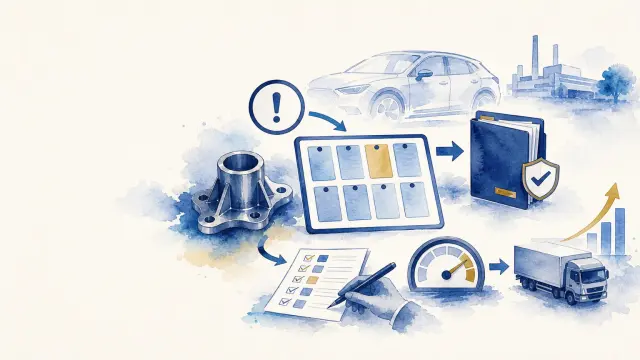
Automotive suppliers operate between ISO 9001, customer-specific requirements, complaint deadlines, delivery performance, change approvals, sampling or release interfaces and regular audit pressure from customers.
The practical challenge is that many requirements sit outside the standard: supplier manuals, contracts, portals, audit reports, quality agreements or 8D expectations. These requirements must become visible in the QMS, otherwise they remain individual knowledge.
A robust system brings error causes, immediate containment, corrective actions, effectiveness checks, supplier communication and management review together. This is where recurring complaints are either prevented or repeated.
I support extending ISO 9001 structures with automotive customer requirements: complaint logic, 8D structure, change control, metrics, supplier control and traceable release processes.
Customer requirements are not only collected but translated into responsibilities, process steps and evidence. It becomes clear which requirements must be actively controlled in daily operations.
Before customer audits, I check whether processes, metrics, actions and interview partners are robustly prepared. The goal is a system that can be explained consistently even under detailed customer questioning.
Automotive customers expect fast reaction and robust evidence. The decisive point is whether the ISO 9001 system actively controls customer-specific requirements instead of storing them in isolated portals.
Are requirements from supplier manuals, quality agreements, audit reports and portals known, assessed and translated into processes?
Are containment, root causes, corrective actions and effectiveness considered separately and supported by traceable data?
Is it clear which changes may be approved internally and when customer information, sampling or additional approvals are required?
Are on-time delivery, complaints, concessions, rework and escalations reviewed regularly and included in management decisions?
Are critical sub-suppliers, purchased parts and outsourced processes monitored so customer risks are visible before a complaint occurs?
Can process owners explain how customer requirements are controlled in daily work and which actions arose from past findings?
Failure causes, containment, corrective actions and effectiveness checks are clearly separated.
More on Complaints and 8DSpecific requirements are translated into processes, evidence and responsibilities.
More on Customer and supplier requirementsTechnical and organizational changes remain traceable with customer requirements, approvals and evidence.
More on Changes and approvalsDelivery performance, complaints, audit results and actions become manageable.
More on Metrics and management reviewThe focus is evidence, response speed and stable interfaces.
Relevant customer specifications, audit reports and complaint data are assessed.
Critical workflows such as change, inspection, complaint and supplier control are sharpened.
Internal audits and action tracking show whether implementation works in daily operations.
After customer audits or complaints, speed matters, but so does reliability. Actions must be reported on time and also cover causes, responsibilities, effectiveness and affected interfaces.
I help connect 8D logic, action plan, change control, supplier actions and management review. Customer findings then stabilize the quality process instead of being handled as isolated cases.
Foundation for quality management in supplier environments.
More on ISO 9001Manage environmental and supply-chain requirements systematically.
More on ISO 14001Integrate safety across production, assembly and logistics.
More on ISO 45001Protect production, customer and supply-chain data.
More on ISO 27001Use AI in development, production and quality assurance with clear controls.
More on ISO 42001Briefly describe your situation, the relevant standard and your timeline. You will receive a personal assessment and a concrete suggestion for the next step.
The focus is ISO management systems and practical quality processes. IATF-specific certification questions should be clarified separately with specialists or certification bodies where needed.
Yes. A good ISO 9001 system can include many customer-specific requirements if processes and records are extended properly.
That depends on customer requirement, scope of supply, supply chain position and certification demand. ISO 9001 can build many foundations, but it does not replace a required IATF certification.
Typical topics are complaints, 8D logic, action effectiveness, delivery performance, change control, suppliers, inspections, metrics and customer-specific requirements.
They should be centrally captured, assessed and mapped to processes. Changes from portals, supplier manuals or quality agreements must reach owners and be implemented traceably.
If purchased parts or outsourced processes influenced the failure, supplier analysis, containment, corrective actions and effectiveness evidence need to flow into the 8D logic.
Concessions should be time-limited, traceable and linked to cause assessment. They must not become a permanent bypass of the regular process.
Internal audits show whether customer-specific requirements, complaints, metrics and actions are understood in daily work. They reduce the risk that customers find the same weak points first.