01
Process parameters
Are critical parameters, process windows, releases and deviation limits documented and controllable for process owners?
High-tech manufacturing needs precise processes and traceable evidence. I help connect technical reality and ISO requirements in an understandable way.
In laser optics, photonics and semiconductor environments, inspections, environmental conditions, suppliers, changes and traceability are especially sensitive.
The management system must reflect technical complexity without burdening expert teams with generic text. The goal is clear responsibility, reliable records and suitable inspection logic.
Where tolerances are small, process windows narrow and customer requirements high, the QMS must make technical decisions traceable without slowing development and production teams.
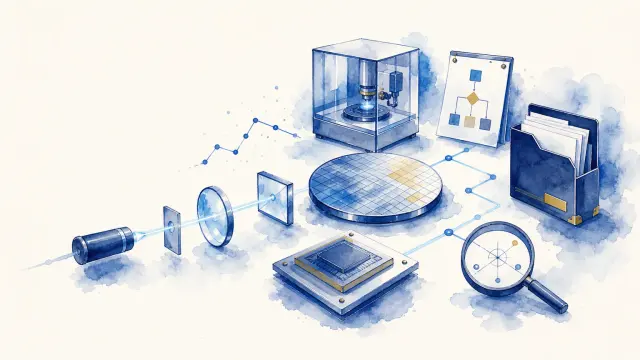
High-tech manufacturing often uses ISO 9001 as a base, supplemented by customer specifications, inspection and acceptance requirements, cleanliness or environmental requirements, calibration logic, special processes, technical approvals and supplier requirements.
Audit-critical questions are often in the details: Which parameters are process-critical? Which measuring devices are approved? How is traceability secured? Who decides on deviations? Which changes must customers or suppliers know?
An effective management system does not flatten this technical logic. It translates it into responsibilities, records and escalation points so expertise is preserved and becomes audit-ready.
I connect technical process information with ISO requirements: process map, inspection planning, measuring equipment, releases, change control, traceability, supplier control, deviations and management review.
Existing technical documents, inspection records, specifications and production data are not replaced but embedded sensibly in the QMS structure. The important point is that the thread is understandable for auditors, customers and internal teams.
Before audits, I check with you which technical evidence is critical and whether process owners can explain it clearly. That reduces risk in customer and certification audits.
In laser optics, photonics and semiconductors, audits often focus on technical evidence. The QMS must show why process decisions are technically sound and reproducible.
Are critical parameters, process windows, releases and deviation limits documented and controllable for process owners?
Is measuring equipment suitable, calibrated, traceable and linked to an impact assessment when equipment is found faulty?
Are cleanliness, climate, handling or environmental requirements monitored and systematically assessed when deviations occur?
Can materials, batches, inspections, releases, process parameters and customer requirements be brought together when needed?
Are processes whose results cannot be fully verified afterwards sufficiently validated, monitored and supported by competence records?
Is it defined when an internal change is enough, when customers must be informed and which evidence is needed before re-release?
Critical process steps are described so requirements, parameters and evidence remain traceable.
More on Special processesInspection planning, records, releases and deviations are aligned with product and customer risks.
More on Traceability and inspectionsMeasuring equipment, environmental conditions, cleanliness requirements and calibration logic are included in evidence management.
More on Environment and measuring equipmentSupplier evaluation, change control and customer communication are connected with the QMS.
More on Suppliers and changesConsulting starts with your real technical workflows and translates them into a verifiable management system.
Process steps, inspections, environmental conditions and customer requirements are captured.
Records, releases and responsibilities are compared with risks and standard requirements.
Internal audits and management review show whether the system holds up under technical detail questions.
Audit findings in high-tech environments often have technical causes or impacts. Actions therefore need to be linked with process parameters, measuring equipment, specifications, releases and customer requirements.
I help close nonconformities not only formally, but by clarifying their technical impact. This includes impact assessments, re-releases, changed inspection or process logic and traceable communication with customers or suppliers.
Build quality management for technical processes.
More on ISO 9001 ConsultingControl energy, chemicals and environmental aspects reliably.
More on ISO 14001Control hazards in production, laboratories and cleanrooms.
More on ISO 45001Protect development, process and customer data.
More on ISO 27001Supply precision components for medical devices with audit-ready controls.
More on ISO 13485Govern AI-supported high-tech processes with traceable controls.
More on ISO 42001Briefly describe your situation, the relevant standard and your timeline. You will receive a personal assessment and a concrete suggestion for the next step.
Not necessarily more, but more precise documentation. It should cover critical parameters, responsibilities and evidence where risks arise.
Consulting does not replace process development, but connects technical information with standard requirements, audit logic and management system structure.
Cleanliness and environmental requirements are controlled through process requirements, responsibilities, inspections, releases and records. Deviations and limits must be handled traceably.
Depth depends on product and customer risk. Critical inspections should be planned clearly, performed with approved equipment, recorded traceably and assessed when deviations occur.
Such processes need clear parameters, qualification, monitoring, releases and, where needed, validation logic. The QMS must show how process reliability is achieved.
Customer specifications are often audit-critical because they add technical detail beyond ISO 9001. They must be reviewed, versioned, distributed and assessed when changed.
Critical suppliers should be assessed by risk, specification, evidence obligations and performance data. Deviations must consider technical impact, releases and customer communication.