01
Order clarification
Are customer requirements, technical specifications, delivery dates, deviations and changes clearly reviewed and approved before production starts?
Manufacturing companies need management systems that connect quality, environment, occupational safety and delivery reliability without overloading operations with paperwork.
In mechanical engineering, quality often depends on interfaces: sales, design, purchasing, production, assembly, inspection and service. The management system must be tangible exactly there.
I support setup and maintenance of integrated systems so requirements from standards, customers and operations come together in a useful workflow.
Value emerges when the system is part of production rather than beside it: inspections, releases, complaints, suppliers, safety and metrics are controlled in one rhythm.
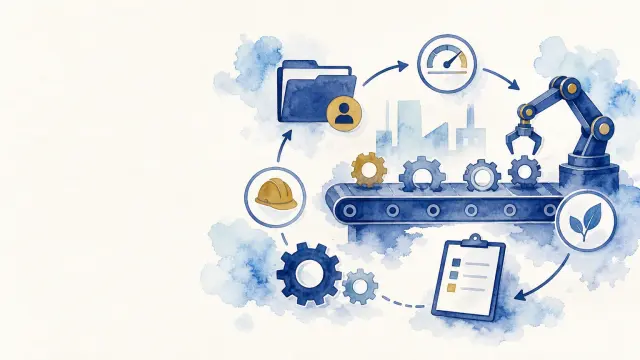
Manufacturing companies often combine ISO 9001 with environmental and occupational safety requirements. Customer audits, technical specifications, measuring equipment requirements, supplier requirements, CE or documentation interfaces and assembly or service requirements add further expectations.
Weak points are often not missing process descriptions, but unclear handoffs: What was promised to the customer? Which inspections are needed? Who releases deviations? Which changes must purchasing, production, assembly and service know?
An effective management system makes these handoffs visible and reduces repeat errors, rework and audit stress. It must stay close enough to the shopfloor so employees can create evidence without detours.
I structure quality, environmental and occupational safety requirements so they fit existing workflows. This includes process map, roles, inspection planning, measuring equipment, supplier evaluation, complaint handling, action tracking and management review.
Where documents, ERP data, inspection plans or digital checklists already exist, they are used first. Consulting here means making existing control audit-ready and understandable, not building a parallel system.
Before certification or customer audits, I check whether records match production reality: from order through purchasing and manufacturing to delivery, assembly and complaint handling.
Auditors and customers in production companies look closely at the link between order clarification, technical clarification, manufacturing, inspection, delivery and complaint handling.
Are customer requirements, technical specifications, delivery dates, deviations and changes clearly reviewed and approved before production starts?
Is it traceable which characteristics are checked when, which measuring equipment is used and how faulty results are handled?
Are measuring and test devices identified, calibrated, suitable and assessed for product impact when deviations occur?
Are suppliers evaluated by risk, performance and critical parts, and do supplier issues feed into actions and management review?
Are internal errors, customer complaints and rework evaluated so causes become visible and repeat errors decrease?
Do quality, environmental and safety records fit together or are separate lists, objectives, audits and actions created without shared control?
Order clarification, inspections, complaints, supplier evaluation and measuring equipment are structured for audits.
More on Quality processesISO 14001 and ISO 45001 can be linked with quality processes without building parallel systems.
More on Environment and safetyMeasuring equipment, inspection steps, releases and deviation decisions remain traceable in the audit.
More on Measuring equipment and releasesBefore certification or customer audits, processes, metrics and evidence are reviewed realistically.
More on Audit preparationConsulting follows your real workflows, not abstract model processes.
Processes from inquiry to delivery are compared with standard and customer requirements.
Existing forms, checklists and digital systems are used where they work.
Internal audits, actions and management review are linked to production reality.
Audit findings in production often affect several areas at once: design, purchasing, production, inspection, warehouse, assembly or service. Closing an action formally is not enough. It must arrive in the workflow.
I help prioritize actions by risk and effect, clarify responsibilities and anchor evidence where the process happens. Internal audits, metrics and management review then become real control tools.
Quality management for stable processes.
More on ISO 9001Manage environmental aspects in production and supply chains.
More on ISO 14001Manage occupational health and safety systematically.
More on ISO 45001Align medical-device supplier processes for audits.
More on ISO 13485Briefly describe your situation, the relevant standard and your timeline. You will receive a personal assessment and a concrete suggestion for the next step.
Often yes. Quality, environment and occupational safety share many structures: responsibilities, objectives, audits, actions and management review.
Not unnecessarily. Good evidence is created close to the process and should support the workflow, not block it.
ISO 9001, ISO 14001 and ISO 45001 are often integrated. Shared audits, objectives, risks, actions and management review reduce duplication.
Enough to make critical workflows, inspections, responsibilities and decisions traceable. Page count is less important than usable evidence.
Yes, if they provide reliable evidence. Responsibilities, data quality, approvals and evaluation must be understandable in the QMS.
Findings should be prioritized by risk, analyzed for causes and translated into concrete process changes. Sending documents afterwards rarely fixes recurring interface problems.